Why Fit Is the Most Powerful Thing in Your Wardrobe
There is a particular kind of authority that enters a room before a person does. It is not manufactured by a luxury label, nor is it borrowed from a trending silhouette. It is the quiet, unmistakable signal of clothing that fits — genuinely, precisely, intentionally fits. In a culture saturated with fast options and algorithmic trends, the art of proper fit has become something rarer and, consequently, far more powerful.
The Psychology of Precision
Researchers in the field of enclothed cognition — a term coined by social psychologists Hajo Adam and Adam Galinsky — have long argued that what we wear shapes not only how others perceive us, but how we perceive ourselves. When a garment aligns with the body it inhabits, something measurable shifts in the wearer's bearing. Shoulders settle differently. Posture lengthens. The body moves with a fluency that ill-fitting clothes fundamentally obstruct.
Sylvia Park, a wardrobe consultant based in New York who has worked with executives across industries, puts it plainly: "My clients often come to me believing they need a completely new wardrobe. Nine times out of ten, what they actually need is a tailor." The transformation she describes is not merely aesthetic. "When someone puts on a jacket that sits correctly across the shoulders, that breaks at exactly the right point on the sleeve — you watch their entire demeanor shift within seconds. They stand taller. They speak with more certainty. The garment stops being something they're wearing and becomes something they're inhabiting."
This distinction — wearing versus inhabiting — is central to understanding why fit functions as a form of currency in both professional and personal environments.
The Hidden Cost of 'Close Enough'
American retail, by structural necessity, is built around standardized sizing. A size medium is engineered to fit a statistical average, not an actual human being. The result is that most Americans are walking around in clothing that is perpetually close enough — close enough in the shoulder, close enough in the chest, close enough in the trouser break — but never quite right.
This chronic approximation carries a cost that rarely appears on a price tag. A blazer with a collar that gaps subtly at the back communicates carelessness, regardless of its origin. Trousers that pool at the ankle create visual noise that undermines even the sharpest shirt. Conversely, a well-tailored garment from a mid-market brand will consistently outperform a poorly fitted luxury piece. The label inside a collar is invisible to everyone in the room. The way a jacket sits across the back is not.
Dr. Karen Leighton, a behavioral psychologist who studies nonverbal communication in professional settings, notes that observers make rapid assessments based on fit. "We process clothing as an extension of the body. When there is visual dissonance — excess fabric, poor proportion, a silhouette that doesn't correspond to the wearer's frame — it registers subconsciously as a lack of attention to detail. And in professional contexts, that perception transfers directly to assumptions about competence."
Tailoring Is Not a Luxury — It Is a Strategy
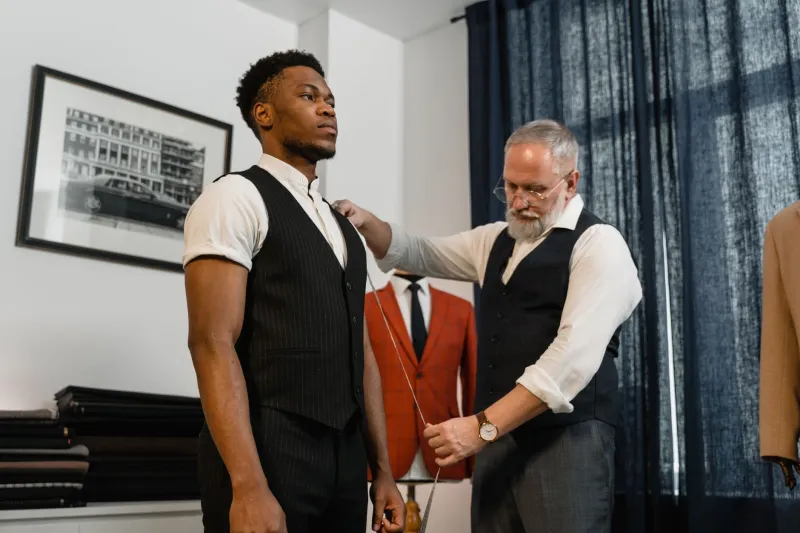
The word "tailoring" carries associations that can feel intimidating or unnecessarily formal, particularly for those who have never walked into an alterations shop. But the reality of what a skilled tailor can accomplish — and what it costs — is far more accessible than the mythology suggests.
A basic trouser hem runs between fifteen and thirty dollars at most alterations shops across the country. Taking in the waist of a pair of trousers costs slightly more. A jacket sleeve adjustment, often the single most transformative alteration a man or woman can make to a blazer, typically falls in the thirty-to-sixty-dollar range. These are not extravagances. They are the difference between clothing that works and clothing that merely exists in a closet.
The strategic approach is straightforward: identify the pieces in your wardrobe that you reach for consistently — the trousers you wear to important meetings, the blazer that anchors your most composed outfits, the dress that appears at every occasion where you need to feel capable — and invest in their precision. A single tailoring appointment can recalibrate the entire psychological weight of a garment.
Fit Across Every Category
The principle of precision is not limited to suiting or formalwear. It applies with equal force across every category of dress.
In casual wear, a well-fitted crewneck sweater — one that sits correctly across the shoulder seam and doesn't overwhelm the torso — reads as deliberately composed rather than accidentally comfortable. Denim that fits through the seat and thigh without excess fabric creates a clean line that elevates the entire outfit. Even a simple white t-shirt, when it skims the body correctly and falls at the right point on the hip, becomes a statement of quiet confidence.
The relationship between fit and formality is also worth examining. Properly fitted casual clothing often communicates more sophistication than poorly fitted formal wear. A man in a blazer that pulls across the chest and bunches at the back is visually less commanding than a man in a well-fitted chore coat that sits cleanly on his frame. The category of the garment matters less than the precision with which it is worn.
Building a Fit-First Wardrobe
Adopting a fit-first philosophy requires a modest reorientation of priorities when shopping. Before asking whether you love a piece, ask whether it fits — or whether it could be made to fit with reasonable alterations. Before adding a garment to your wardrobe, consider whether it flatters your specific proportions or simply approximates the look you're after.
This approach naturally encourages a more deliberate, edited wardrobe. When every piece is chosen and adjusted for precision, the wardrobe becomes smaller, more coherent, and exponentially more effective. You stop accumulating and start selecting.
Park's advice to her clients is consistent: "Build your wardrobe around fit, not around volume. Ten pieces that fit you perfectly will carry you further — professionally, socially, personally — than forty pieces that almost work."
The Quiet Statement
There is something inherently sophisticated about clothing that fits well. It suggests intentionality. It implies that the wearer has taken the time to understand their own body, their own proportions, their own relationship to the clothes they choose to inhabit. In a world where most people are content with close enough, precision is a form of distinction.
Confidence, ultimately, is not something that can be purchased off a rack. But it can be cultivated — through deliberate choices, through the discipline of fit, through the understanding that a garment's true value is not what it costs, but how completely it serves the person wearing it.
Fit is not a finishing touch. It is the foundation upon which every other element of style rests.