The Mirror Problem: When Your Wardrobe Stops Reflecting Who You Actually Are
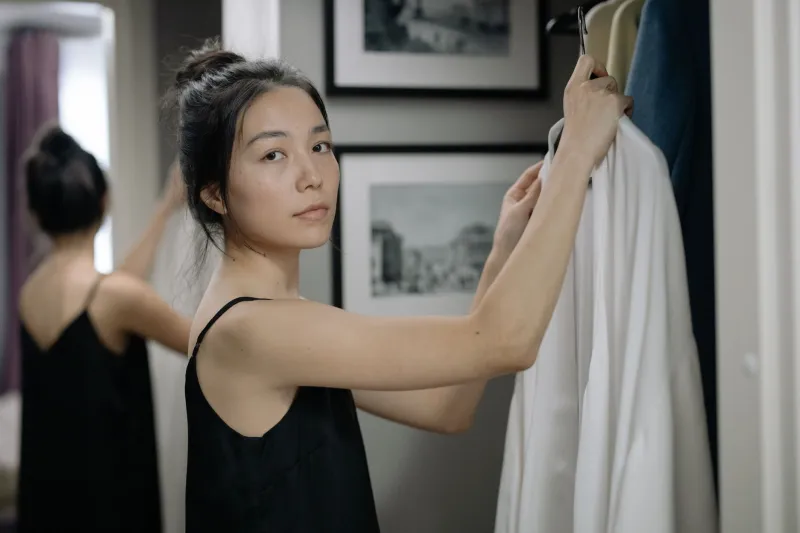
There is a particular kind of frustration that visits on otherwise ordinary mornings. You stand before an open closet — one that is, by most measures, well-stocked — and feel nothing. Not excitement, not ease, not even mild satisfaction. Just a low-grade anxiety and the creeping sense that nothing in front of you quite belongs to you anymore.
This is not a shopping problem. It is an identity problem. And it is far more common than the fashion industry would like you to believe.
The Clothes That Look Right but Feel Wrong
Most of us have accumulated wardrobes in layers, the way cities accumulate architecture. There are pieces from a previous job, a former relationship, a phase of life we have quietly outgrown. There are aspirational purchases — the blazer bought for the person we intended to become, the dress selected for an occasion that never materialized. And then there are the impulse acquisitions, the sale-rack decisions, the gifts we kept out of obligation.
Individually, many of these garments are objectively fine. They photograph well. They earn compliments. On a hanger, they make perfect sense. But the moment we put them on, something shifts. The fit is technically correct, yet the garment feels borrowed. We spend the day tugging at a hem, second-guessing a neckline, or simply feeling — without being able to articulate why — that we are wearing a costume rather than clothes.
This disconnect has a name in psychological circles: identity incongruence. When what we wear fails to align with our internal self-concept, the resulting discomfort is not vanity. It is a legitimate signal worth paying attention to.
Body Image and the Clothes We Punish Ourselves With
One of the most insidious contributors to wardrobe friction is the habit of dressing for a body we do not currently inhabit. This takes two forms. The first is the aspirational wardrobe — pieces purchased in a smaller size as motivation, hanging unworn as a quiet indictment. The second is the opposite: continuing to dress in ways that minimize or conceal, long after the emotional reason for doing so has passed.
Both patterns share a common root: the belief that our current body does not deserve clothes that fit properly, feel good, and reflect genuine personal taste. This is worth examining with some rigor. Clothes that fit the body you have today — not the body you had five years ago, not the body you are working toward — are not a compromise. They are a basic prerequisite for feeling like yourself.
The most sophisticated wardrobe in the world will fail if the foundational relationship between wearer and garment is one of negotiation rather than ease.
Lifestyle Misalignment: The Wardrobe Built for Someone Else's Life
Another source of quiet closet dysfunction is what might be called lifestyle lag — the gap between the life your wardrobe was designed for and the one you are actually living. A wardrobe assembled during years of corporate office culture will not serve someone who has shifted to remote work and weekend travel. A collection built around evening social occasions will feel oppressive to someone whose priorities have moved toward early mornings and active weekends.
This kind of misalignment is rarely dramatic. It accumulates slowly, one slightly-wrong purchase at a time, until the whole system feels vaguely off. The solution is not to overhaul everything at once, but to audit with honesty: How many days per week do I actually need this type of garment? When did I last wear this category of clothing and feel genuinely comfortable? What does my real life — not my ideal life, my real one — actually require?
Answering these questions with candor is more useful than any shopping guide.
The Unspoken Dress Codes We Absorb Without Realizing It
Style does not develop in a vacuum. From childhood onward, we absorb messages about what people like us are supposed to wear — from family, from regional culture, from professional environments, from the specific social circles we move through. Many of these messages are never spoken aloud. They operate as invisible constraints, quietly shaping our choices and generating guilt or discomfort when we deviate from them.
A woman who grew up in a household where dressing up was considered pretentious may feel inexplicable unease when she reaches for something elegant. A man who works in an industry where suits signal formality rather than authority may resist a tailored wardrobe even when it would genuinely serve him. These internalized codes are worth identifying, because until you name them, they continue to make decisions on your behalf.
Style confidence — the kind that reads as effortless and authentic — is largely the product of having reconciled these inherited scripts with your own genuine preferences. That reconciliation takes time, but it begins with awareness.
Practical Strategies for Closing the Gap
Rebuilding alignment between your wardrobe and your actual self is not a weekend project, and it is not primarily about shopping. It is about developing clarity — on who you are, how you live, and what you want the act of getting dressed to feel like.
Begin with subtraction, not addition. Before purchasing anything new, remove what consistently generates friction. Pieces that require a particular mood to wear, that you pass over every single morning, or that make you feel less like yourself the moment you put them on — these are not assets. They are noise.
Dress for the life you have this week, not the life you aspire to eventually. Your wardrobe should serve your actual schedule, your real commitments, the genuine texture of your days. Aspirational dressing has its place, but not at the expense of daily functionality and ease.
Pay attention to how you feel, not just how you look. The mirror is one data point. How a garment feels to move in, how it holds up across a full day, how you feel at 4 p.m. when the adrenaline of a new purchase has worn off — these matter equally.
Identify the three or four occasions that constitute ninety percent of your actual life. Build from those outward. Everything else is secondary.
The Wardrobe as Self-Knowledge
There is something quietly radical about a wardrobe that genuinely fits — not just in the physical sense, but in the deeper sense of alignment with who you are and how you live. It removes a layer of daily friction that most people have simply accepted as normal. It makes the act of getting dressed feel less like a negotiation and more like an expression.
That quality of ease is not reserved for people with larger budgets or more refined taste. It is available to anyone willing to look honestly at the gap between the wardrobe they have assembled and the person standing in front of it — and to close that distance, one deliberate choice at a time.